
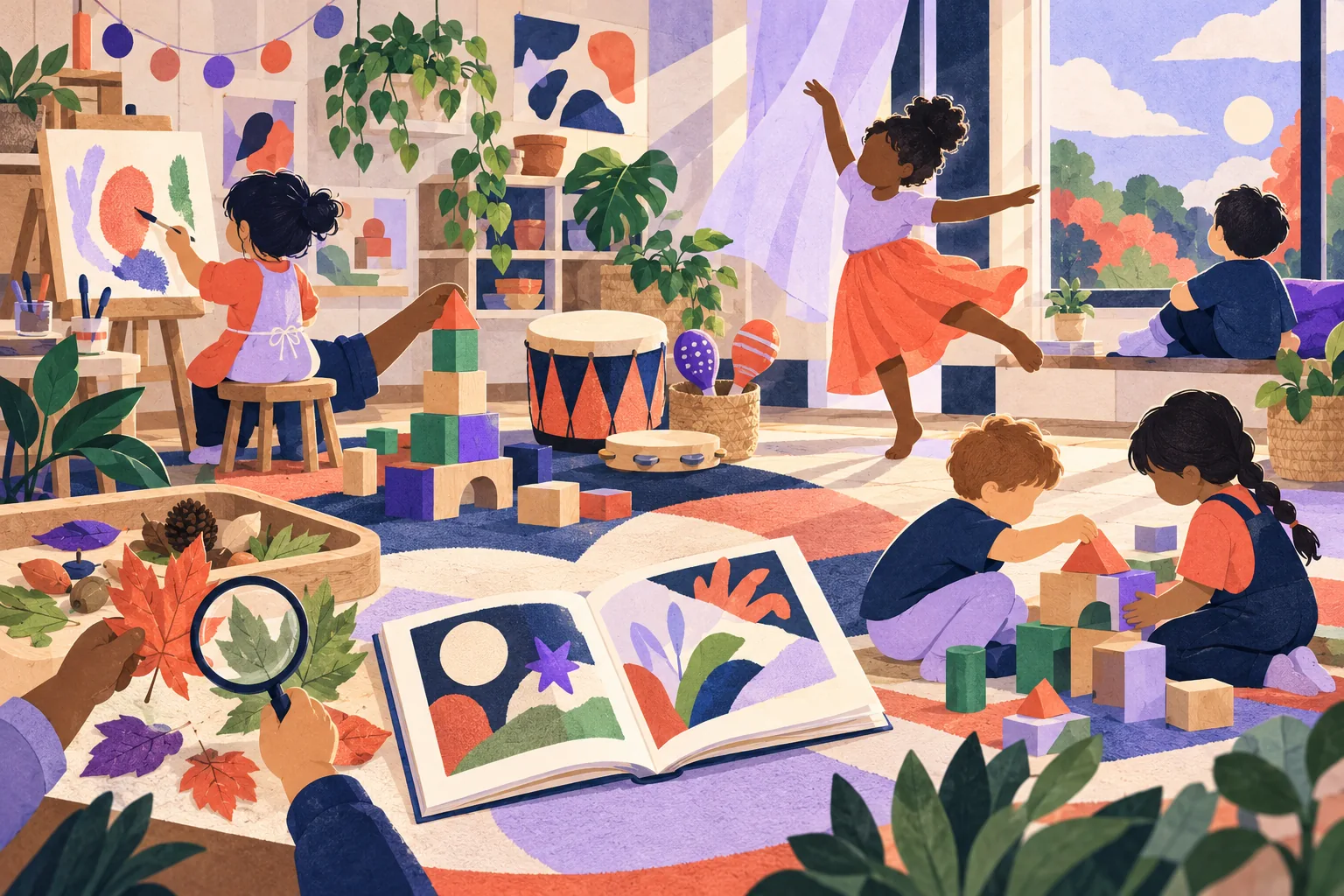
Ask a room of adults to name a creative child and most will picture the one at the easel. The child who builds a ramp that finally works, who makes up a rhyme to calm a friend, or who notices that the ants have moved their nest is being creative too. They are just not doing it with paint.
Howard Gardner’s theory of multiple intelligences is one of the most useful lenses an early childhood educator can use to see that wider creativity. It is also the framework Joy Lubawy chose for her book Visions of Creativity in Early Childhood, which draws on her 30 years as a teacher and director in Australian early childhood centres.
This article explains what the theory says, what it does not say, and what each kind of intelligence can look like in a preschool or long day care room.
What is creativity in early childhood?
Creativity in young children is less about producing something impressive and more about having an idea and trying it out. It covers making new connections, asking “what if?”, solving a problem in an unexpected way, and finding a way to express a thought or feeling.
That definition matters, because it makes creativity something every child can do, not a talent a few children have. The publisher’s description of Visions of Creativity makes the same point: creativity is relevant to every child, not only to future artists and performers.
Gardner’s theory in brief
Howard Gardner, a psychologist at Harvard, introduced the theory of multiple intelligences in his 1983 book Frames of Mind. Instead of one general intelligence, he proposed several relatively independent ones. He later added a naturalist intelligence, attunement to the living world, which he described in Intelligence Reframed (1999).
The intelligences most often used in education are:
| Intelligence | In a sentence |
|---|---|
| Linguistic | Sensitivity to words, sounds and meanings |
| Logical–mathematical | Pattern, quantity, cause and effect |
| Spatial / visual | Seeing, imagining and arranging space and form |
| Musical | Rhythm, pitch, melody and sound |
| Bodily–kinaesthetic | Thinking and expressing with the body and hands |
| Interpersonal | Understanding and working with other people |
| Intrapersonal | Understanding one’s own feelings and thinking |
| Naturalist | Noticing, classifying and caring for the natural world |
A caution: intelligences are not learning styles
Gardner himself has written that multiple intelligences are not “learning styles” (Harvard Graduate School of Education, 2013). The theory is not a reason to label a child “a musical learner” and teach them only through songs. Its value is the opposite. It reminds us that every child has many capacities, and that a rich program offers ways in through all of them.
Eight ways in: creativity across the intelligences
Visions of Creativity in Early Childhood gives a chapter to each of these dimensions, followed by a chapter on programming, planning, evaluation and documentation. The notes below show the kind of thinking each lens opens up. They are a starting point, not a summary of the book.
Visual and aesthetic
Creativity here is not only painting. It is choosing, arranging and noticing: a child who sorts the collage box by colour, or arranges leaves into a pattern on the path.
- Offer open materials (fabric, natural objects, loose parts) as well as paint and crayons.
- Ask children what they notice before asking what they made.
Musical and rhythmic
Rhythm and song invite children to invent: new verses, new actions, new instruments. Joy’s own songs for young children are built for exactly this. Several invite children to add their own words.
- Leave space in familiar songs for children to fill in a word or action.
- Make simple instruments available outside of “music time”.
Kinaesthetic
Movement is thinking for many young children. Creativity shows up in invented games, dances and new ways of using equipment.
- Ask “can you find another way to get across?” rather than demonstrating the one right way.
Mathematical and logical
Patterns, building, sorting and “how many?” questions are full of creative problem-solving, especially when the problem is the child’s own.
- Treat a collapsing block tower as an investigation, not a failure: “What could make it stronger?”
Naturalist
Gardens, insects, weather and seasons invite questions with no fixed answers, and that is fertile ground for creative thinking.
- Keep a “wonder wall” for children’s questions about the natural world and come back to them.
Linguistic
Stories, rhymes, jokes and made-up words are early creative writing, long before children can write.
- Write down children’s stories exactly as they tell them, and read them back to the group.
Interpersonal
Creativity is often social: negotiating a game’s rules, inventing a role in dramatic play, solving a disagreement in a new way.
- Notice and name creative collaboration: “You two found a way to share the boat.”
Intrapersonal
Reflection is a quiet form of creativity: children making sense of their feelings, choosing how to express them, imagining how things could be different.
- Offer calm spaces and materials for children to express feelings without words.
Putting it into a program
The theory is most useful at the planning stage. A simple check: over a week, does the program offer a way in through each of these intelligences? If most experiences are linguistic and visual, children whose strengths lie elsewhere have fewer chances to be seen as creative.
Australian educators planning against the Early Years Learning Framework (V2.0, 2022) can use the intelligences as a lens alongside the framework’s learning outcomes. The lens does not replace them.
Documentation closes the loop. Photographs, children’s words and short notes make children’s creative thinking visible to families and to the children themselves. This is the focus of the final chapter of Visions of Creativity.
Further reading
Visions of Creativity in Early Childhood: Connecting Theory, Practice and Reflection by Joy Lubawy takes each intelligence in turn, with stories from Australian early childhood rooms and ideas from Reggio Emilia and the emergent curriculum. It is available in an Australian edition from Pademelon Press and an American edition.
If you are weighing up the Reggio Emilia approach and emergent curriculum, read Emergent curriculum vs Reggio Emilia: how they fit together.
Sources
- Gardner, H. (2013). “‘Multiple intelligences’ are not ‘learning styles'”. Republished by Harvard Graduate School of Education: https://www.gse.harvard.edu/ideas/news/13/10/multiple-intelligences-are-not-learning-styles
- Gardner, H. (1983). Frames of Mind. Basic Books.
- Gardner, H. (1999). Intelligence Reframed: Multiple Intelligences for the 21st Century. Basic Books. Listing: https://publishersweekly.com/9780465026104
- Pademelon Press, Visions of Creativity in Early Childhood product page (description and chapter list): https://www.pademelonpress.com.au/product/visions-of-creativity-in-early-childhood/
- ACECQA, Belonging, Being and Becoming: The Early Years Learning Framework for Australia V2.0 (2022).


